Dairyland Greyhound Track


The Dairyland Greyhound Track is officially closing December 31, 2009. As happy as I am about the 500+ dogs that will no longer be abused for the amusement of humans and will finally get to experience a real, happy and fulfilling life, I am aware that our society has a long ways to go when it comes to treating animals humanely. We still have greyhound race tracks scattered across the country, with dogs living in conditions very similar to that of puppy mills (living in cages, no human interaction, no mental or physical stimulation of toys/walks/dog parks, questionable healthcare, no controlled temperature, etc). We still have horse tracks that promote racing horses at too young of an age, pumping them full of drugs, and simply killing them when they become injured or are no longer fast enough. We still have bull fighting, cock fighting, dog fighting…

So while this is a great victory for dogs and the animal rights movement, it is a very small victory. Unfortunately, the race track is not shutting down because they realized that what they were doing was inhumane or because Wisconsin passed an animal welfare law forcing them out of business. They are shutting down because they were no longer making enough money. We must continue to push for animal fighting to be illegal with hefty punishments if caught, for animal race tracks to be shut down, and for puppy mills to no longer exist. Abusing animals for pleasure should be illegal and we must not rest until it is.

On a related note, these 500+ dogs are going to be needing homes/foster homes very soon! Greyhounds are amazing dogs and make great family pets. Please visit http://www.gpawisconsin.org and consider supporting them in any way you can, whether it is with opening your home for foster care or just donating a bottle of bleach, every little bit helps!

(picture taken from http://www.gpawisconsin.org)

The issue with pet limit laws


Most cities have a law in place that limits the number of animals a household can have. Mine, for example, only allows two dogs maximum. (Yes, now you know, I am a law-violator!) The idea behind instituting a pet limit law is to avoid hoarding, animal cruelty and neglect, noise violations, and sanitation issues. While these concerns are valid and I commend the area councils for caring about the welfare of companion animals, the pet limit law does not actually address these concerns.

The issue here is that the people passing these pet limit laws assume that more animals in the house automatically leads to these violations. Not so! Simply having a lot of animals in one’s house does not immediately mean the animals are not well cared for and are a nuisance to the neighbors. There needs to be actual acts of neglect and an inability to provide for the animals in one’s care for there to be any real violations of neglect. Take a foster home for example. Many wonderful individuals volunteer their time, resources and hearts to help local shelters care for their animals. However, what happens if I have two dogs and am fostering a third? The law is forcing me to not help my local shelter and this therefore directly results in more animals being unnecessarily killed because the shelter does not have sufficient room to care for its animals on its own.

The flip side of this law is also an issue as it assumes everyone is capable of caring for up to two dogs at a time. I personally know of several people who do not have the resources or current know-how to care for even just one dog. The pet limit law does not address this type of individual nor does it protect the animals that are under this individual’s care. Rather, it focuses only on one section of pet owners (the multiple pet people) and punishes both the good and bad within that section. If a person has the resources and is perfectly capable of caring for five dogs and is able to do so without the neighbors being overly burdened by it, then why should they not be able to?

So be proactive! Contact your local representatives and ask them to repeal your local pet limit law. Instead, make sure they have a law (or laws) in place addressing hoarding, animal cruelty and neglect, noise violations, and sanitation so that all companion animals, whether an only child or with multiple siblings, are protected. Individuals who are willing and able to care for multiple animals should be able to while people who are unable to even care for one companion animal should be monitored and reported if they attempt to do so.

I will probably write more on this topic at a later date as it is one that lies close to my heart (obviously, I have three dogs and a cat in my house and am hoping to foster one of the freed greyhounds from the Dairyland Greyhound Park). Please comment/ask questions and I will definitely address them either now or in a later post. Thanks for reading!

The truth about declawing


There are usually two main reasons why people decide to declaw their cat: fear of furniture damage and fear of human injury. I will go through the two issues and explain why declawing is actually not the answer. Then I will explain why declawing is an overall bad idea.

Furniture Damage
If you are concerned about your cat scratching furniture, please see my earlier entry about working with your cat’s nails and teaching them to stop scratching. A cat can be trained! The key is to provide an appropriate object for scratching, typically a scratching post, so your cat can act out the instinctive need to stretch, scratch and mark with his scent.

Children/Visitors
If you are worried about your children’s safety, please keep in mind that a cat gives off very distinct body language that you and your family should learn. If your cat does not want to be picked up or petted any more, you can tell! The more the tail is moving, the more agitated the cat and therefore the cat should be left alone. Also, if a cat’s ears are back and/or eyes are dilated (but you are in a well lit area), the cat is on high alert and likely easily startled. And this point is rather obvious, but your children may not realize it: if the cat is hiding leave him alone! He wants to be alone and will not be happy if disturbed. So teach your children to look for these signs before the approach your cat. That way, no scratching will occur!

Another topic to discuss with visitors and children is that most cats do not like to be held or picked up. They do not like to feel confined and therefore will struggle if handled. So make sure everyone understands not to pick up or hold down your cat!

Just Say No to Declawing
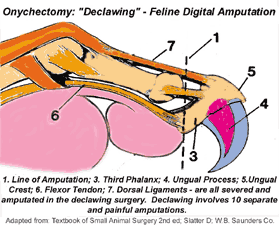
The option of declawing was very popular up until about five years ago when people began to realize the true extent of the damage done with this surgery. Most people think that declawing the cat is simply removing their nails when in fact you are removing their finger from the first joint. Even if your cat makes it through the surgery without complications, there are long term issues that have been proven to occur. A cat’s claws are their first line of defense. When a cat is tired of a child pestering them, they give a few swats of their paw as a warning. However, if a cat figures out their paws no longer work effectively to ward off unwanted attention they will resort to their second line of defense-their teeth. So it comes down to deciding if you would rather be scratched when your cat is grumpy or bitten.

Another behavior issue that can arise from declawing is peeing outside the litter box. When a cat loses his fingers through the declawing surgery his feet do not feel the same anymore. Some cats will respond to this discomfort (or, if the healing did not occur properly, pain) by avoiding strange surfaces. Like cat litter.

Declawing is a very hard thing for a cat to adjust to and therefore you should NEVER declaw a cat over the age of one. Take humans for example. If you take me, a 25 year old, and cut my fingers off it will take me a long time to adjust to this disability since I have lived with fingers for 25 years. However, if you take a newborn baby and cut her fingers off, that is all she knows while growing up and will therefore have less of an issue adjusting to the disability.

You should always discuss with your veterinarian about this surgery if you are considering it, but keep in mind your vet may recommend it because it means more money for them.
(image taken from http://www.declawing.com)

How to teach your dog "sit"

As always, the first step is to find a treat your dog is really willing to work for! Once this treat has been identified, break them up into small pieces (no bigger than your pinky fingernail).

Essentially when you are teaching your dog a command, you will first teach them the result you are looking for (in this case, sit) and once that is learned you are putting a verbal command to it. So to teach the result of sit, first take the small treat in your hand and slowing move it from a little bit above your dog’s nose backwards to over their head and towards their back. Keep it close to their head so they can smell it! This motion of moving a treat over their head towards their back will almost always result in your dog putting his backside down so he can get to the treat. Once your dog does sit down, give him the treat immediately! Dogs only have an association period of about 1.5 seconds, so you need to get that treat to him in 1.5 seconds for him to understand that butt on ground=treat.

Do this about a dozen times or so to make sure your dog is making the connection. Once your dog seems to be predicting what you want when you put the treat out, add the word “sit” into the mix. So every time your dog puts his backside on the ground, say sit and give the treat. Do this a few more dozen times and your dog should have it! Try just holding the treat in your hand, close to your chest, and say “sit.” If he sits, praise him and give him that treat as soon as you can.

Do not be discouraged if your dog takes a while to catch on, some dogs are better at learning new things than others. Just keep doing each step over and over until your dog gets the hang of it before you move on to the next step. Some dogs figure this out in minutes (like my border collie mix) while others take a bit longer (just like my chihuahua mix-he took a few days).

Reminder: dogs get frustrated just like we do, so don’t train with your dog for more than 15 minutes at a time. That way, he can retain everything you are trying to teach him and not get so frustrated that he shuts down and you have set backs.

How to crate train your dog

Midwest Life Stages Double-Door Folding Metal Dog Crate, 36"L x 24"W x 27"HSo you just adopted your new family member and are ready to crate train her. Here are a few simple steps to ensure your training success!
1. Make sure the crate you have is the right size for your dog. Your dog should be able to stand, turn around, and lay down comfortably. Do not get too big of a crate or the potty training will not work because a large crate will give your dog the opportunity to create a “potty space” in the crate.

2. Put the crate in a semi-secluded area. I usually put mine in the laundry room by my back door. The reason for this is to work with your dog’s instincts. Wolves sleep in dens and see this space as a safe, secure place to be. In introducing the crate to your dog, you are going to make the crate her “den”. In fact, my dogs all know to go in their crates by the verbal command “den time”!

3. Make sure to introduce the crate to your dog slowly. Put a treat right inside the door of the crate and let your dog get it. Work your way with several treats into the crate until the treat is at the back of the crate and your dog has to go all the way in to get it.

4. Next, put another treat in the back of the crate and when your dog goes all the way in, close the door. Give her another treat and then open the door right away. Keep doing this a few more times, but each time make the closed door period a little longer.

5. Do #3 again, but this time leave the room once the door is closed. Just like #3 keep doing this and increase the amount of time you are gone each time you do it. Always praise the dog for being good when you give the treat and then open the door.

6. If your dog is crying in the crate, do not rush to open the door or even verbally comfort her. If you respond to the whining, your dog will learn that whining=you come and let her out. Instead, wait her out and once she stops crying give her a small treat and then open the door. This way she will know that crying does not get her what she wants, but if she is good and remains quiet she gets to be by you!

7. If you have a puppy, please be mindful of the length of time she can hold her bladder. A good rule of thumb is how old a dog is in months is about how many hours she can hold her bladder. So a 3 month old puppy has to go potty about every 3 hours. You should NEVER leave a dog in a crate for more than 9-10 hours at a time. Every dog, no matter what breed or age, needs to get outside and get some food/water/exercise and attention from you!

8. Once your dog is completely trained, you can leave her loose in the house while you are gone. However, because your dog now views this space as her den it is best to keep it out for her. Many times when I come home from work, I will find my dog sleeping in his den at his own free will. It’s a safe place for him and I don’t think it right to take it away!

Remember, the crate is being introduced as (and should remain) a safe, secure environment for your dog. Always use a happy tone of voice when putting your dog in her crate and NEVER use the crate as a form of punishment.

Also a reminder about treats – a little goes a long way! These steps may seem treat intensive, but the treats you are giving out should not be bigger than your pinky finger nail (even smaller if you have a small breed).

Why you should crate train your dog

It’s a potty training tool – if introduced correctly, the crate will be seen as your dog’s “den.” Since the den is meant to be a bedroom of sorts, your dog does not want her area to be dirty. Therefore, the majority of dogs will not go to the bathroom in their crates. HOWEVER: please be mindful of the length of time your dog can hold her bladder. With puppies, good rule of thumb is how old a dog is in months is about how many hours she can hold her bladder. So a 3 month old puppy has to go potty about every 3 hours. You should NEVER leave a dog in a crate for more than 9-10 hours at a time. Every dog, no matter what breed or age, needs to get outside and get some food/water/exercise and attention from you!

It’s a house training tool – when you have a new dog in the house, there is a very good chance she does not know the rules of the house. For example, she may believe everything in the house is fair game when it comes to toys. How is she supposed to know what’s okay to chew on and what’s not? The best way to teach her is to take away whatever she is playing with that she shouldn’t be and replace it with an acceptable toy. If you are not home, you are not able to do this. Therefore, it is good to put the dog in her crate while you are gone so she cannot get into trouble. Most dogs, especially puppies, are very curious and can get themselves into trouble very quickly when unsupervised. So until your dog is completely trained, it is best to have her in her crate while you are gone so she does not harm herself.

Once your dog is completely trained, you can leave her loose in the house while you are gone.

What to do about your cat’s claws

So you have a cat and you’re afraid he is going to scratch everything (including you) to pieces. What are your options and which one is the best for you? I will go through the most common options and layout the pros and cons of them so you can make an educated decision when the time comes.

1. Declaw. This option was very popular up until about five years ago when people began to realize the true extent of the damage done with this surgery. Most people think that declawing the cat is simply removing their nails when in fact you are removing their finger from the first joint. Even if your cat makes it through the surgery without complications, there are long term issues that have been proven to occur. A cat’s claws are their first line of defense. When a cat is tired of a child pestering them, they give a few swats of their paw as a warning. However, if a cat figures out their paws no longer work effectively to ward off unwanted attention they will resort to their second line of defense-their teeth. So it comes down to deciding if you would rather be scratched when your cat is grumpy or bitten.

Another behavior issue that can arise from declawing is peeing outside the litter box. When a cat loses his fingers through the declawing surgery his feet do not feel the same anymore. Some cats will respond to this discomfort (or, if the healing did not occur properly, pain) by avoiding strange surfaces. Like cat litter.

Lastly, declawing is a very hard thing for a cat to adjust to and therefore you should NEVER declaw a cat over the age of one. Take humans for example. If you take me, a 25 year old, and cut my fingers off it will take me a long time to adjust to this disability since I have lived with fingers for 25 years. However, if you take a newborn baby and cut her fingers off, that is all she knows while growing up and will therefore have less of an issue adjusting to the disability.

I have, and always will, recommend that this not even be an option for you. However, if you want to consider it I ask that it be your very last resort.

2. Softpaws. There are soft rubber caps you can apply to your cat’s nails that render them useless when it comes to doing damage. Applying the nail caps is about as hard as cutting your cats nails since it involves you touching their nails for a few minutes total. Just trim your cat’s nails, fill the nail caps half way with the provided nail glue and press onto their nail. The caps should last about a month before they will star to fall off. Sometimes it helps to just do one paw at a time and take breaks so your cat can settle down. One issue I have noticed with these caps is that especially active cats like to chew them off. However, I would say about 9 out of 10 cats I have put these caps on do not even notice they are on.

If you are worried that doing nail caps every month for the rest of your cat’s life is too much, do not worry! See my next suggestion and combine the two until your cat is completely trained. That way, during training your cat is still not able to do any damage.

3. Training. Yes, you can train a cat! One of the ways to train a cat to stop scratching is with a water squirt bottle. Whenever your cat walks up to the couch and starts to put his paws on it, give him a short squirt of water on the back. The trick is to make your cat think magic is occurring. Stay with me here-if your cat sees that the water is coming from you, he will just think you’re a jerk and will wait until you are gone to go to town on your sofa. However, if your cat thinks the couch is spraying him with water every time he touches it he will not go near it!

A great way to help redirect your cat away from the couch is to put a scratching post a few feet away from the spot they like to scratch. Rub it down with cat nip and then place double stick tape over the hot spot on the couch. So when your cat goes to his favorite scratching spot, finds a sticky mess and then smells cat nip we all know where he is going to go!

4. Nail trimming. You should already be trimming your cat’s nails about once every two weeks. However, you can trim them more often to avoid their nails ever getting sharp. My cat, Loki gets his nails trimmed once a week and they never are able to do any real damage as he wrestles with the dogs. Just remember that when cutting their nails, do not cut into the red area-there are nerves and blood there! Just cut the white area at the tip.

5. Do nothing. Sure, maybe after a few weeks of your cat living in your house you learn he does not use his claws for the evil purpose of killing your living room couch. If you have no reason to believe your cat is going to be destructive with his claws, then just leave him be! Do remember that just like our nails, cat nails keep growing and need to be trimmed regularly. I recommend at least once every two weeks, more if you want to keep them blunt at all times. Also, even if your cat does not seem interested in scratching anything, it is a good idea to provide a scratching post of some kind just in case the instinct kicks in.

As always, please feel free to ask questions or post comments! I am also happy to take article suggestions if you have an idea. Thanks!

Stop the Leash Pulling

If your dog is pulling on the leash to the point where they are choking themselves or controlling you, there are ways to make them stop!

First, don’t even think about using a pinch or choker collar. The only thing these collars will do for you is cause permanent damage to your pet’s throat. Most dogs will still pull on the leash with these collars on anyways.

A harness is usually the best way to keep control of your dog and not hurt them. There are several types of harnesses out there, but the best one for a strong dog is the sensible harness. The leash attaches to the front of the dog’s chest as opposed to some harnesses that have the leash attach to the back. The reason for this is because if the leash is attached to the front (chest) and the dog pulls, his whole body will turn to the side. This teaches the dog that pulling does not get him to where he wants to go since pulling turns his body away from the object he is trying to get to.

If you have a smaller dog or a dog that is not very strong, a harness that attaches the leash on the back of the dog is fine. This will protect the dog’s esophagus and help you keep better control of the dog.

If you don’t want to get a harness, you can teach your dog to walk along side you with just a collar on. Make sure you have lots of great treats in your pocket. Whenever your dog pulls on the leash, just stop walking and stand there. Once the dog gives the leash some slack, praise them and give them a treat. The first few times you do this it will take a long time just to go around the block, but don’t get frustrated! With some patience and consistency with stopping whenever they pull, your dogs will figure it out pretty quickly that pulling doesn’t get them to where they want to go and that if they walk along side you there are treats to be had!

Remember – it is always a good idea to figure out what kind of treat your dog really loves. These are considered high value treats and your dog will work hard to get one!

Getting a Second Cat

So you have a cat and now you want to get a second one. In fact, it is true that most cats do best in pairs so looking for a buddy is probably a good idea. But before you head off to the local animal shelter, there are a few things you need to know to ensure two happy cats and a happy you.

  1. Cats do best with friends of the same sex. The reason for this is female cats tend to be more reserved and independent while male cats are the “eternal kittens” who are more playful and outgoing. Therefore, putting a reserved cat with a crazy playful one does not work out too well. Also, male cats play differently than females. The males are much more rough and tumble while the females are a little less aggressive in their play behavior. The exception to this rule is if you have a really outgoing female or a really reserved male. The main point here is to match their personalities as much as possible.
  2. Cats do best with friends close to their age. So if you have a 12 year old cat, it is highly unlikely this cat will get along with a 4 month old kitten. I’m not saying that if you have a senior cat you should not get another cat. However, if you have an older cat that has been your only cat for a long time, you may want to keep it that way so that she can enjoy the rest of her life in peace. But if your senior cat is still really active and/or just recently lost a companion, then just make sure to get another adult (3 years+) cat.
  3. Introducing two cats is actually a long process. The new cat should be set up in a room all by himself with his litter box, food, water, toys, bed, etc. You resident cat should not be allowed into this room at all. After a day or two, take your new cat’s bed and maybe a toy or two and switch them with your resident cat’s things. This will allow the two cats to smell each other without them actually seeing each other. The next day or two, swap the cats. Put your resident cat in the room and let the new cat check the house out. Soon the two will be ready to meet. Give them time, let them check each other out and if things get heated, just separate them again for a few more days. This process can take up to two weeks, so be patient.
  4. Another reason why you want to put your new cat in just one room at first is because cats tend to hide when they feel threatened. So your new cat will very likely hide when he gets out of his carrier and you are going to want to know where he is! Instead of having to search your entire home to figure out where the cat is, you just have to find him in one room.
  5. The general rule is you should have as many litter boxes (or more!), water bowls and food bowls as you have cats. The reason for this is that cats are very clean and picky creatures so they will not use a dirty water bowl or a smelly litter box. There are always exceptions to the rule, but you should be safe rather than sorry. If a cat finds a litter box unsatisfactory, she will find a different place to go to the bathroom and no one wants cat pee on their bed.
  6. In these times of economic struggle, you should also ask yourself if you can afford a second cat. The day to day expense of a cat is not that much, but imagine if your cats get into a poisonous plant or one of them breaks a leg. Vet bills, especially the emergency room, can get into the thousands within minutes. Please seriously think about this before you decide to commit to your new family member.
  7. This is the most important factor when considering to get another cat: Make sure to get your next cat from the local animal shelter! There are many amazing cats in shelters that deserve homes and they will be forever grateful to you.

If you have any questions, comments, or concerns, please let me know! I am happy to help you with any of your animal issues.