The truth about declawing


There are usually two main reasons why people decide to declaw their cat: fear of furniture damage and fear of human injury. I will go through the two issues and explain why declawing is actually not the answer. Then I will explain why declawing is an overall bad idea.

Furniture Damage
If you are concerned about your cat scratching furniture, please see my earlier entry about working with your cat’s nails and teaching them to stop scratching. A cat can be trained! The key is to provide an appropriate object for scratching, typically a scratching post, so your cat can act out the instinctive need to stretch, scratch and mark with his scent.

Children/Visitors
If you are worried about your children’s safety, please keep in mind that a cat gives off very distinct body language that you and your family should learn. If your cat does not want to be picked up or petted any more, you can tell! The more the tail is moving, the more agitated the cat and therefore the cat should be left alone. Also, if a cat’s ears are back and/or eyes are dilated (but you are in a well lit area), the cat is on high alert and likely easily startled. And this point is rather obvious, but your children may not realize it: if the cat is hiding leave him alone! He wants to be alone and will not be happy if disturbed. So teach your children to look for these signs before the approach your cat. That way, no scratching will occur!

Another topic to discuss with visitors and children is that most cats do not like to be held or picked up. They do not like to feel confined and therefore will struggle if handled. So make sure everyone understands not to pick up or hold down your cat!

Just Say No to Declawing
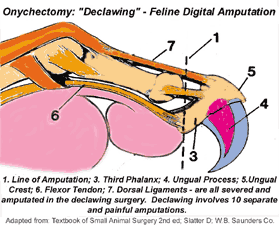
The option of declawing was very popular up until about five years ago when people began to realize the true extent of the damage done with this surgery. Most people think that declawing the cat is simply removing their nails when in fact you are removing their finger from the first joint. Even if your cat makes it through the surgery without complications, there are long term issues that have been proven to occur. A cat’s claws are their first line of defense. When a cat is tired of a child pestering them, they give a few swats of their paw as a warning. However, if a cat figures out their paws no longer work effectively to ward off unwanted attention they will resort to their second line of defense-their teeth. So it comes down to deciding if you would rather be scratched when your cat is grumpy or bitten.

Another behavior issue that can arise from declawing is peeing outside the litter box. When a cat loses his fingers through the declawing surgery his feet do not feel the same anymore. Some cats will respond to this discomfort (or, if the healing did not occur properly, pain) by avoiding strange surfaces. Like cat litter.

Declawing is a very hard thing for a cat to adjust to and therefore you should NEVER declaw a cat over the age of one. Take humans for example. If you take me, a 25 year old, and cut my fingers off it will take me a long time to adjust to this disability since I have lived with fingers for 25 years. However, if you take a newborn baby and cut her fingers off, that is all she knows while growing up and will therefore have less of an issue adjusting to the disability.

You should always discuss with your veterinarian about this surgery if you are considering it, but keep in mind your vet may recommend it because it means more money for them.
(image taken from http://www.declawing.com)

What to do about your cat’s claws

So you have a cat and you’re afraid he is going to scratch everything (including you) to pieces. What are your options and which one is the best for you? I will go through the most common options and layout the pros and cons of them so you can make an educated decision when the time comes.

1. Declaw. This option was very popular up until about five years ago when people began to realize the true extent of the damage done with this surgery. Most people think that declawing the cat is simply removing their nails when in fact you are removing their finger from the first joint. Even if your cat makes it through the surgery without complications, there are long term issues that have been proven to occur. A cat’s claws are their first line of defense. When a cat is tired of a child pestering them, they give a few swats of their paw as a warning. However, if a cat figures out their paws no longer work effectively to ward off unwanted attention they will resort to their second line of defense-their teeth. So it comes down to deciding if you would rather be scratched when your cat is grumpy or bitten.

Another behavior issue that can arise from declawing is peeing outside the litter box. When a cat loses his fingers through the declawing surgery his feet do not feel the same anymore. Some cats will respond to this discomfort (or, if the healing did not occur properly, pain) by avoiding strange surfaces. Like cat litter.

Lastly, declawing is a very hard thing for a cat to adjust to and therefore you should NEVER declaw a cat over the age of one. Take humans for example. If you take me, a 25 year old, and cut my fingers off it will take me a long time to adjust to this disability since I have lived with fingers for 25 years. However, if you take a newborn baby and cut her fingers off, that is all she knows while growing up and will therefore have less of an issue adjusting to the disability.

I have, and always will, recommend that this not even be an option for you. However, if you want to consider it I ask that it be your very last resort.

2. Softpaws. There are soft rubber caps you can apply to your cat’s nails that render them useless when it comes to doing damage. Applying the nail caps is about as hard as cutting your cats nails since it involves you touching their nails for a few minutes total. Just trim your cat’s nails, fill the nail caps half way with the provided nail glue and press onto their nail. The caps should last about a month before they will star to fall off. Sometimes it helps to just do one paw at a time and take breaks so your cat can settle down. One issue I have noticed with these caps is that especially active cats like to chew them off. However, I would say about 9 out of 10 cats I have put these caps on do not even notice they are on.

If you are worried that doing nail caps every month for the rest of your cat’s life is too much, do not worry! See my next suggestion and combine the two until your cat is completely trained. That way, during training your cat is still not able to do any damage.

3. Training. Yes, you can train a cat! One of the ways to train a cat to stop scratching is with a water squirt bottle. Whenever your cat walks up to the couch and starts to put his paws on it, give him a short squirt of water on the back. The trick is to make your cat think magic is occurring. Stay with me here-if your cat sees that the water is coming from you, he will just think you’re a jerk and will wait until you are gone to go to town on your sofa. However, if your cat thinks the couch is spraying him with water every time he touches it he will not go near it!

A great way to help redirect your cat away from the couch is to put a scratching post a few feet away from the spot they like to scratch. Rub it down with cat nip and then place double stick tape over the hot spot on the couch. So when your cat goes to his favorite scratching spot, finds a sticky mess and then smells cat nip we all know where he is going to go!

4. Nail trimming. You should already be trimming your cat’s nails about once every two weeks. However, you can trim them more often to avoid their nails ever getting sharp. My cat, Loki gets his nails trimmed once a week and they never are able to do any real damage as he wrestles with the dogs. Just remember that when cutting their nails, do not cut into the red area-there are nerves and blood there! Just cut the white area at the tip.

5. Do nothing. Sure, maybe after a few weeks of your cat living in your house you learn he does not use his claws for the evil purpose of killing your living room couch. If you have no reason to believe your cat is going to be destructive with his claws, then just leave him be! Do remember that just like our nails, cat nails keep growing and need to be trimmed regularly. I recommend at least once every two weeks, more if you want to keep them blunt at all times. Also, even if your cat does not seem interested in scratching anything, it is a good idea to provide a scratching post of some kind just in case the instinct kicks in.

As always, please feel free to ask questions or post comments! I am also happy to take article suggestions if you have an idea. Thanks!